French students challenge the Republic's promise of equality in new protests
A growing student movement in France is highlighting the gap between constitutional ideals and the reality of underfunded public schools, drawing on historical precedents and modern cultural symbols.
By News Media House Staff ·
The French Republic is founded on the motto of liberty, equality, and fraternity, a promise that every citizen learns from a young age. However, more than two centuries after its establishment, the nation continues to struggle with the practical application of these founding principles. Public institutions are theoretically designed to serve the common good regardless of a citizen's origin or social background. Yet, when students in under-resourced Parisian suburbs and rural areas protest against missing teachers and deteriorating school conditions, they are challenging a system that promises equal opportunity while providing fewer resources to many young people.
The constitutional framework is explicit on this matter. The 1789 Declaration of the Rights of Man and of the Citizen establishes equality in rights, and the Preamble to the 1946 French Constitution defines public education at all levels as a duty of the state. Despite these legal assurances, the quality of schools often depends on geography and family wealth. This discrepancy causes the state to lose credibility as the guarantor of the general interest, particularly when opportunity remains heavily dependent on the circumstances of one's birth.
This contradiction carries historical weight in France, where the 1789 Revolution abolished the legal foundations of hereditary privilege that had burdened the Third Estate. While the government is not the Ancien Régime and today's students are not a new Third Estate, the core question of equality persists. Social privilege continues to reproduce itself through family wealth, access to professional networks, and geographic location. The mechanisms have changed, but the fundamental problem of unequal access to merit-based advancement has not disappeared.
Public schools are central to this current movement because they are supposed to enable social mobility and make merit more important than birth. When students protest over a lack of teachers and adequate facilities, they are confronting the failure of an institution designed to make equality real. It is difficult for a system to hold young people responsible for their success if it fails to equip their schools with the necessary resources. This struggle over the authority of a centralized state is a recurring theme in French history, distinct from but connected to previous uprisings.
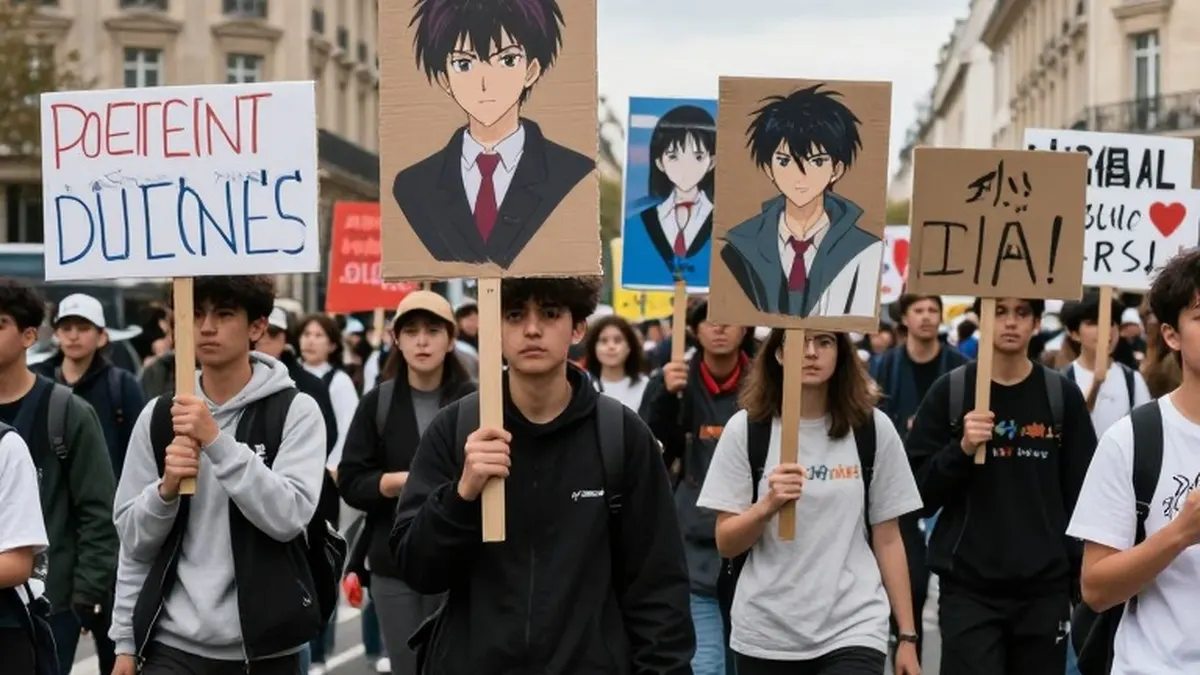
Historical precedents such as the May 1968 student unrest and the 2018 Yellow Vests movement demonstrate that institutions are constantly required to justify their authority. While these movements were different in nature, they shared a demand that the state honor its promises to the public. Today, student protesters are developing a distinct cultural language to express their solidarity and defiance. References to anime, manga, and fictional worlds such as Dragon Ball and the Avengers have appeared in demonstrations alongside creative slogans and costumes.
These symbols allow young demonstrators to recognize one another and communicate across different cities without relying on traditional political organizations. This cultural expression should not be mistaken for political shallowness; rather, it makes abstract ideas about justice and freedom tangible. However, the state has often responded to these protests with a focus on security and the use of force, treating the demonstrations as a problem of public order rather than a warning about the condition of public institutions.
France's experience after the 2015 terrorist attacks illustrates how exceptional powers can become normalized, with some emergency measures incorporated into ordinary law in 2017. A government risks undermining its legitimacy when it appears more capable of containing the consequences of institutional failure through force than of correcting the failures themselves. The Republic has yet to eliminate every way in which privilege reproduces itself, and the students are forcing that unfinished question back into public life.
Many of the students currently in the streets will be eligible to vote in the April 2027 presidential elections. If the government's response remains condescending, it may harden the determination of these young voters to participate in the election process. A higher youth turnout could potentially benefit the left, provided that the political party seizes the opportunity to reconnect with younger generations and offers a solid alternative to the status quo.
Originally published by News Media House