SpaceX loses booster to Gulf explosion, keeps Starship in orbit
A first-stage failure ended the bid for a double catch, but the upper stage remains on a 22-hour mission to return to the launch pad.
By Giulia Liu ·
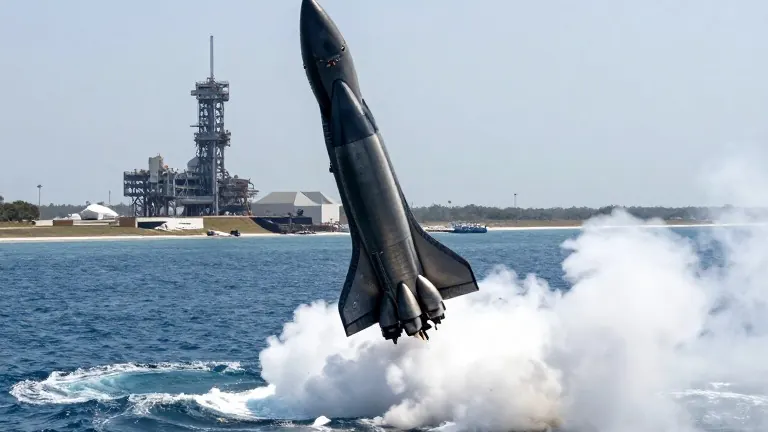
The 407-foot combined height of the SpaceX Starship rocket stands as the tallest object ever lifted from Earth's surface, yet the mission began with a loss on Friday. The first-stage booster, measuring 236 feet, fell into the Gulf of Mexico and exploded shortly after liftoff from the Starbase facility near the U.S.-Mexico border.
SpaceX had intended to retrieve both the booster and the upper stage at the launch tower. This would have been the first time a company caught both stages of a fully reusable rocket in midair. The failure of the booster meant the company missed that specific milestone, though the upper stage continued its ascent.
The spacecraft, which spans 171 feet, is currently in orbit. It dropped off 26 Starlink satellites shortly after reaching space. The vehicle is programmed to complete 15 orbits at an altitude of approximately 170 miles before attempting to steer back to the Texas launch site on Saturday.
The total flight duration could reach 22 hours. Kate Tice, a SpaceX launch commentator, noted that the outcome was not the hoped-for news but aligned with rigorous safety checks. She stated, “Well, that certainly isn’t the news that we had hoped to hear for today.” No specific explanation for the booster failure was provided by the company.
This mission represents the first test of the upgraded production booster intended for lunar and Mars missions. Previous tests had seen the spacecraft portion of 14 Starships end in the ocean. The last test in September reached orbit but did not attempt recovery. SpaceX has previously captured three boosters at the Starbase pad.
Kiko Dontchev, vice president of launch at SpaceX, outlined the company's strategy at a NASA tech summit last week. He stated that full reusability allows for scaling launch rates from zero to 100,000 flights. This capacity is essential for building moon bases and sending people to Mars, according to company leadership.
SpaceX plans to begin launching Starships from Florida within months and from Louisiana in a few years. The company aims to replace its smaller Falcon rockets with Starships. Falcon rockets are not fully reusable and discard their second stage on every flight, whereas Starship is designed to catch both stages.
NASA is funding Starship for Artemis missions to land astronauts on the moon. The agency must decide between SpaceX and Blue Origin for the Artemis IV lunar landing. During the Artemis III mission next summer, astronauts will practice docking with a Starship in orbit around Earth, setting the stage for a moon touchdown as early as 2028.
More Business · Business Watchdog · Report a business · Got a Story?